MANAGEMENT GROUP GOVERNANCE · AZURE POLICY · BICEP · REMEDIATION
PROJECT / 03SYSTEM ONLINE
CLOUD POLICY COMPLIANCE DASHBOARDAzure governance that can detect, visualize, alert and automatically restore compliance.
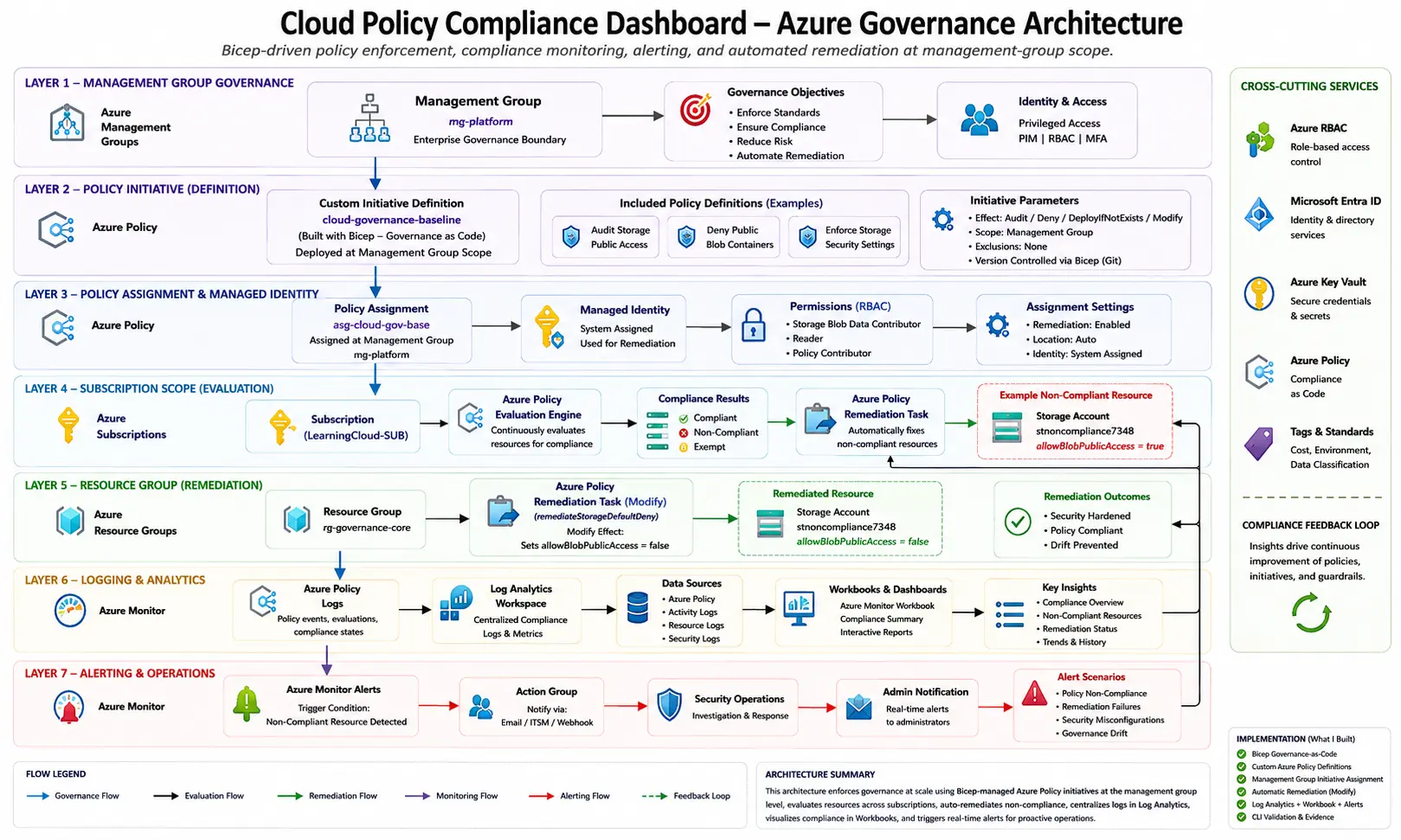
A full Azure governance observability platform built at management-group scope. Custom policies and a Cloud Governance Baseline are deployed as code, non-compliance is visualized through a workbook, Azure Monitor alerts notify stakeholders, and policy remediation hardens Storage Accounts and returns the environment to compliant state.
In many Azure estates, policy exists but operations stop at basic auditing. This project turns governance into an operational platform: standards are defined as code, drift is surfaced visually, alerts notify stakeholders, and remediation can restore compliant configuration.
THE BASELINE
MANAGEMENT-GROUP GOVERNANCE INSTEAD OF ONE-OFF SUBSCRIPTION CHECKS.
A custom Cloud Governance Baseline initiative is assigned at mg-platform. A dedicated governance resource group hosts the workspace, workbook, action group, and alert rules.
Custom policy definitions and initiative deployed with Bicep.
Initiative assigned at management-group scope with managed identity.
Governance workspace centralized in rg-governance-core.
Workbook, alerts, and remediation operationalize policy state.
THE FINISHED STORY
A FULL GOVERNANCE LIFECYCLE, NOT JUST COMPLIANCE REPORTING.
A non-compliant Storage Account is detected, visualized, used to fire an alert, and then automatically remediated. The setting changes, compliance returns to 100%, and the workbook reflects a clean state.
DETECTVISUALIZEALERTREMEDIATERESTORE COMPLIANCE
02 / BUSINESS IMPACT
GOVERNANCE THAT MOVES FROM PASSIVE REPORTING TO OPERATIONAL RESPONSE.
Standardized governance across Azure environments by deploying reusable policy definitions, initiatives, and assignments as code.
Reduced cloud misconfiguration risk by detecting risky Storage Account settings through Azure Policy at management-group scope.
Improved compliance visibility through an Azure Workbook using Azure Resource Graph PolicyResources for live compliance state, with Log Analytics supporting operational telemetry and investigation.
Reduced manual reporting effort with audit-ready compliance views, affected resources, and policy results in one dashboard.
Improved operational response through Azure Monitor alerts and Action Group email notification.
Reduced remediation effort using Azure Policy modify remediation with managed identity.
Proved the complete lifecycle: detect, visualize, alert, remediate, and verify compliance restored to 100%.
03 / GOVERNANCE CONTROLS
HOW THE CONTROLS WORK TOGETHER.
Policy enforces the standard. Azure Resource Graph exposes live policy compliance state to the Workbook. Diagnostic settings stream Activity Log data into Log Analytics for operational telemetry and investigation. Azure Monitor alerts react to drift, while remediation uses the assignment identity to correct a real resource property.
The flow follows the real build: Bicep deployment, management-group policy, centralized governance resources, live policy-state detection through Azure Resource Graph, workbook visualization, operational telemetry through Log Analytics, alerting, managed-identity remediation, and final verification.
CONTROL-PLANE FLOW
01
GitHub repository + Bicep modules
Management group and subscription templates
The repo holds custom policy definitions, initiative wiring, assignment logic, workbook JSON, KQL queries, and subscription-scope governance modules.
02
mg-platform baseline deployment
Azure Policy at management-group scope
Bicep deploys the custom audit policy, remediation policy, and Cloud Governance Baseline initiative to mg-platform, then assigns it with a system-assigned managed identity.
03
rg-governance-core observability layer
Subscription scope
A governance resource group hosts the Azure Workbook, Log Analytics workspace, Action Group, and alerting resources. Workbook compliance views query Azure Resource Graph PolicyResources, while Log Analytics supports operational telemetry and investigation.
04
Diagnostic settings + Policy states
Activity Log to workspace
Subscription Activity Log categories, including Policy, are streamed to the workspace for validation and investigation.
05
Alerting + remediation
Azure Monitor + Azure Policy modify
Alert rules monitor policy state data, action groups deliver notifications, and remediation tasks correct eligible storage properties.
VALIDATION FLOW
01
Create a non-compliant Storage Account
Blob public access and exposure settings create a real policy violation.
02
Force policy scan
The resource appears as NonCompliant in Azure Policy and workbook queries.
03
Validate alerting
The alert fires, appears in history, and sends Action Group email.
04
Grant assignment identity RBAC
Contributor is granted at subscription scope for modify remediation.
05
Run remediation and verify
allowBlobPublicAccess becomes false and policy returns to compliant.
The gallery follows the actual validation story from deployed governance resources and non-compliance through alerting, remediation, and the final compliant state.
06 / VALIDATION WALKTHROUGH
HOW THE PLATFORM WAS TESTED END TO END.
This simulation mirrors the real validation sequence: deploy, create drift, detect it, alert on it, remediate it, and verify the restored configuration.
GOVERNANCE CONTROL RUNDETECT → ALERT → REMEDIATE
01
Deploy management-group baseline
Bicep deploys custom policy definitions, initiative, and assignment to mg-platform.
READY02
Deploy governance resources
rg-governance-core receives the workspace, workbook, action group, and alert rules.
WAITING03
Create violating Storage Account
A deliberately risky configuration produces a real policy violation.
WAITING04
Force policy scan
Policy state becomes NonCompliant and the workbook shows the affected resource.
WAITING05
Validate alerting
The non-compliance alert fires and Action Group email is delivered.
WAITING06
Execute remediation
The assignment-managed identity runs a modify remediation task.
WAITING07
Verify property change
allowBlobPublicAccess changes to false.
WAITING08
Confirm compliance restored
Policy state returns to compliant and the workbook clears.
WAITING
07 / TECH STACK
AZURE-NATIVE GOVERNANCE AND OPERATIONS BUILDING BLOCKS.
CONTROL PLANE
Azure Policy custom definitions
Management-group policy initiative
Bicep management-group and subscription deployments
Managed identity policy assignment
OBSERVABILITY + RESPONSE
Azure Resource Graph PolicyResources
Azure Workbook compliance visualization
Log Analytics workspace for operational telemetry and investigation
ALERT PATHPolicy state → Azure Monitor → Action Group email
REMEDIATION TARGETStorage Account blob public access disabled automatically
FINAL STATEWorkbook clear, policy 100% compliant
09 / CHALLENGES & LESSONS
WHAT BROKE — AND HOW IT WAS FIXED.
The strongest engineering value came from real troubleshooting across policy state queries, workbook behaviour, alerting, assignment identity, and modify remediation.
01Workbook query failed because the wrong table name was used+
The first workbook and alert queries targeted PolicyResources directly. The working path used arg("").PolicyResources for workbook and alert use.
Symptom: workbook tile error and alert query resolution failure.
Fix: switch to arg("").PolicyResources and redeploy workbook JSON.
Outcome: donut, table, and alert logic aligned to the same live policy-state source.
02Activity-based alerting looked correct in theory but failed in practice+
An AzureActivity-based path was explored, but it did not validate consistently enough for the management-group scenario.
Symptom: activity alert deployed but did not produce dependable history.
Fix: retain the validated policy-state non-compliance alert as the primary evidence path.
Outcome: the final project story stayed aligned to what was actually proven.
03The first remediation design targeted the wrong property+
The remediation definition was redesigned around allowBlobPublicAccess because it produced a clean modify-based correction and a verifiable configuration change.
Symptom: accepted remediation with no useful deployments or unchanged resource.
Fix: set allowBlobPublicAccess = false through Azure Policy modify.
Outcome: remediation succeeded and the storage setting changed automatically.
04Remediation required assignment identity and RBAC+
Modify remediation depended on a system-assigned identity on the management-group initiative assignment plus adequate subscription-scope RBAC.
Fix: recreate the assignment with managed identity.
Grant Contributor at subscription scope for the lab remediation path.
Outcome: remediation executed successfully and restored compliance.