← BACK TO PROJECTSPROJECT SYSTEM / AZURE ENTERPRISE INTEGRATION PLATFORM
APIM · LOGIC APPS · SERVICE BUS · DATAVERSE · AZURE MONITOR
PROJECT / 05

AZURE ENTERPRISE
INTEGRATION PLATFORM.

A production-style Azure integration operations platform proving that APIs, workflows, messaging, monitoring, incident recovery, and operational documentation can work together as one supportable cloud system.

Azure API ManagementLogic AppsService BusDynamics 365 / DataverseAzure MonitorPowerShellOperational Runbooks
APIM 202 VALIDATED 45-MESSAGE BACKLOG TESTED PARSE JSON FAILURE FIXED
ARCHITECTURE / LIVE SYSTEM MAPPLATFORM ONLINE
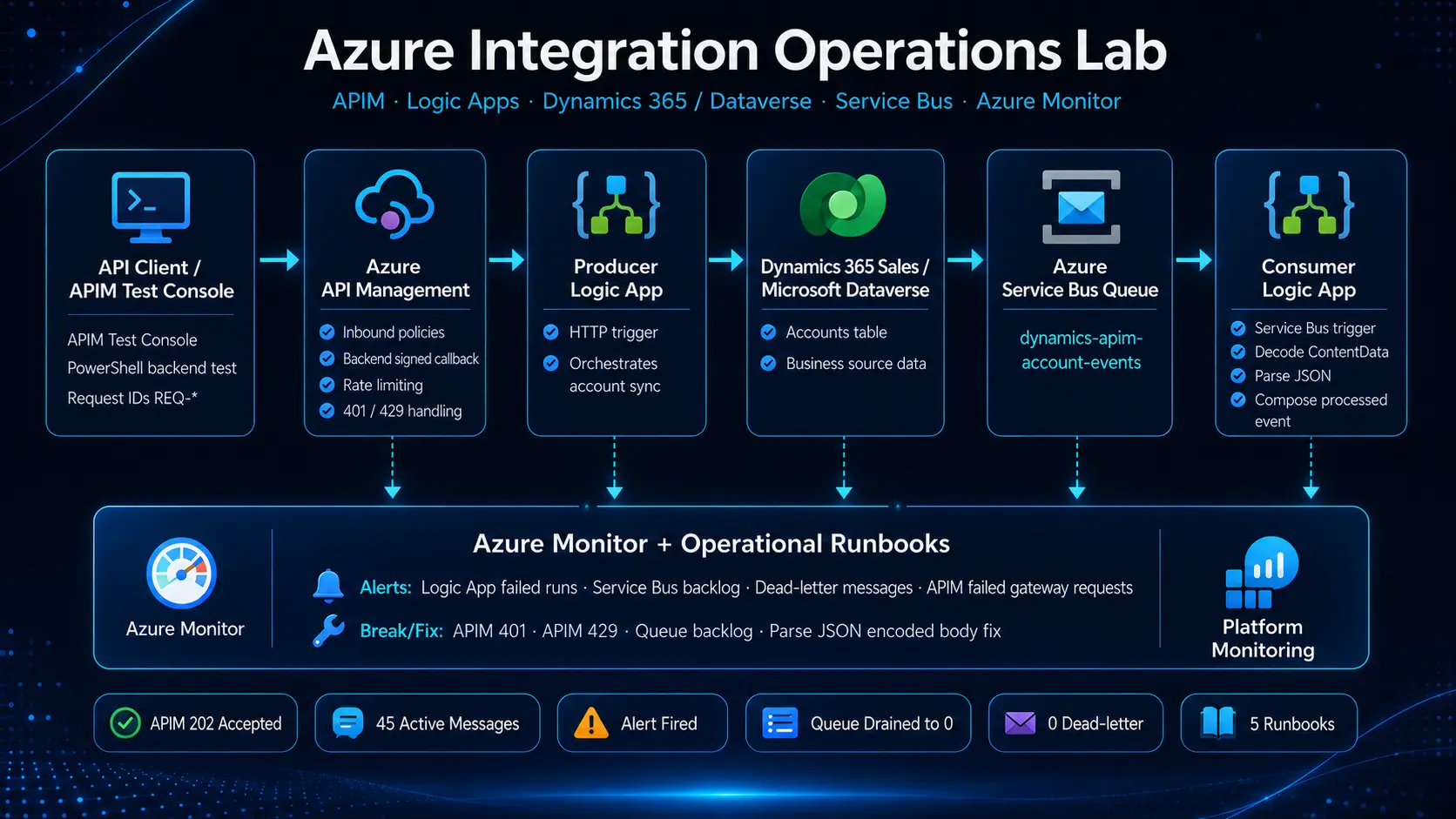
Azure Enterprise Integration Platform architecture
APIMPRODUCERSERVICE BUSCONSUMERMONITOR
01 / SYSTEM OVERVIEW

BUILT, BROKEN, RECOVERED.

THE PLATFORM PATTERN

API-driven business-data integration with queue-based resilience.

API requests enter through Azure API Management and trigger a producer Logic App. The workflow reads account data from Dynamics 365 / Dataverse and publishes events to Service Bus. A separate consumer processes the queued messages, keeping the two sides decoupled.

THE ENGINEERING OUTCOME

A platform tested beyond the happy path.

The environment was deliberately pushed through gateway authentication failure, rate limiting, consumer outage, queue backlog, and encoded-message parsing failure. Each fault was isolated, fixed, validated, monitored, and documented.

202ACCEPTED45ACTIVE MESSAGES0DEAD-LETTER5RUNBOOKS
02 / AZURE ARCHITECTURE

FROM API REQUEST TO PROCESSED EVENT.

Six operational layers form the end-to-end integration path.

01
API GATEWAY

Azure API Management

Controlled ingress, backend routing, and rate limiting.

02
PRODUCER

Logic App

Receives the API request and publishes account events.

03
BUSINESS DATA

Dynamics 365 / Dataverse

Provides the account records used by the integration.

04
MESSAGE BUS

Service Bus Queue

Decouples producer and consumer and absorbs downstream outages.

05
CONSUMER

Logic App

Decodes ContentData, parses JSON, and processes queued events.

06
OBSERVABILITY

Azure Monitor

Monitors gateway failures, workflow failures, queue depth, and dead-letter state.

03 / BREAK / FIX INCIDENTS

FAILURE IS PART OF THE DESIGN.

The strongest evidence comes from faults that were deliberately reproduced, investigated, and recovered.

INC-01

APIM 401 Unauthorized

APIM failed while forwarding to the Logic App backend. A direct PowerShell test returned Accepted, isolating the fault to APIM policy and callback parameters.

BACKEND HEALTHY / POLICY FIXED
INC-02

APIM 429 Rate Limit

The gateway returned 429 after more than three requests in sixty seconds, proving that the configured rate-limit policy protected the backend.

GATEWAY CONTROL VALIDATED
INC-03

Service Bus Backlog

The consumer was deliberately disabled while APIM and the producer remained healthy. The queue reached 45 active messages and triggered the backlog alert.

45 ACTIVE / ALERT FIRED
INC-04

Consumer Parse JSON Failure

Logic App run history showed the Service Bus content was encoded. The parsing step was fixed by decoding ContentData before Parse JSON.

PAYLOAD DECODED / RUN SUCCEEDED
04 / MONITORING & ALERTING

OBSERVABILITY AT EVERY FAILURE POINT.

Monitoring covers the gateway, producer, queue, consumer, and dead-letter path so an integration problem can be detected before it becomes invisible operational debt.

01 / PRODUCER

Failed Logic App runs

Detect failed HTTP-triggered producer executions.

02 / CONSUMER

Failed Logic App runs

Detect consumer failures including parsing errors.

03 / SERVICE BUS

Backlog alert

Detect active messages crossing the operational threshold.

04 / SERVICE BUS

Dead-letter alert

Detect any dead-letter message count greater than zero.

05 / APIM

Failed gateway requests

Support policy, routing, and backend-authentication investigation.

05 / ENGINEERING EVIDENCE

THE PLATFORM, PROVEN IN AZURE.

Architecture, gateway tests, queue health, alerts, failures, recovery, and runbooks from the working environment.

06 / INCIDENT SIMULATOR

SEE HOW THE PLATFORM ABSORBS FAILURE.

A safe browser-only reconstruction of the downstream consumer outage used during the real validation.

SAFE BROWSER SIMULATION

DOWNSTREAM CONSUMER OUTAGE

Mirrors the validated platform incident: producer stays healthy, Service Bus absorbs the outage, monitoring fires, and the queue drains after the consumer is repaired.

APIMREADY
ACTIVE MESSAGES0
DEAD-LETTER0
ALERTCLEAR
CONSUMERENABLED
01
WAITINGAPIM request accepted
02
WAITINGProducer publishes account events
03
WAITINGConsumer unavailable
04
WAITINGService Bus backlog grows
05
WAITINGAzure Monitor alert fires
06
WAITINGConsumer repaired and re-enabled
07
WAITINGQueue drains to zero
07 / OPERATIONAL RUNBOOKS

TROUBLESHOOTING MADE REPEATABLE.

RUNBOOK / 01

Service Bus Backlog Alert Response

Detect → triage → isolate → fix → validate → hand over.

RUNBOOK / 02

Logic App Consumer Parse JSON Failure

Detect → triage → isolate → fix → validate → hand over.

RUNBOOK / 03

APIM 401 Unauthorized to Logic App

Detect → triage → isolate → fix → validate → hand over.

RUNBOOK / 04

APIM 429 Rate Limit

Detect → triage → isolate → fix → validate → hand over.

RUNBOOK / 05

Service Bus Dead-letter Investigation

Detect → triage → isolate → fix → validate → hand over.

08 / LESSONS LEARNED

WHAT THIS PLATFORM PROVED.

01

APIM is more than an endpoint.

Backend authentication, callback parameters, rate limiting, and routing policy all affect whether the integration actually works.

02

Service Bus protects downstream systems.

The producer remained healthy during consumer failure because messages could wait safely in the queue until recovery.

03

Queue drain alone is not proof of success.

Consumer run history and dead-letter state still need to be checked after recovery to confirm clean end-to-end processing.

04

Runbooks convert troubleshooting into operations.

Incident knowledge becomes repeatable when symptoms, triage, remediation, evidence, and validation are documented clearly.